
Daily wear is one of the most powerful and overlooked causes of rexine jacket damage.
Rexine is a synthetic leather surface layered over fabric backing, and its durability depends on the stability of that surface coating under constant movement and contact.
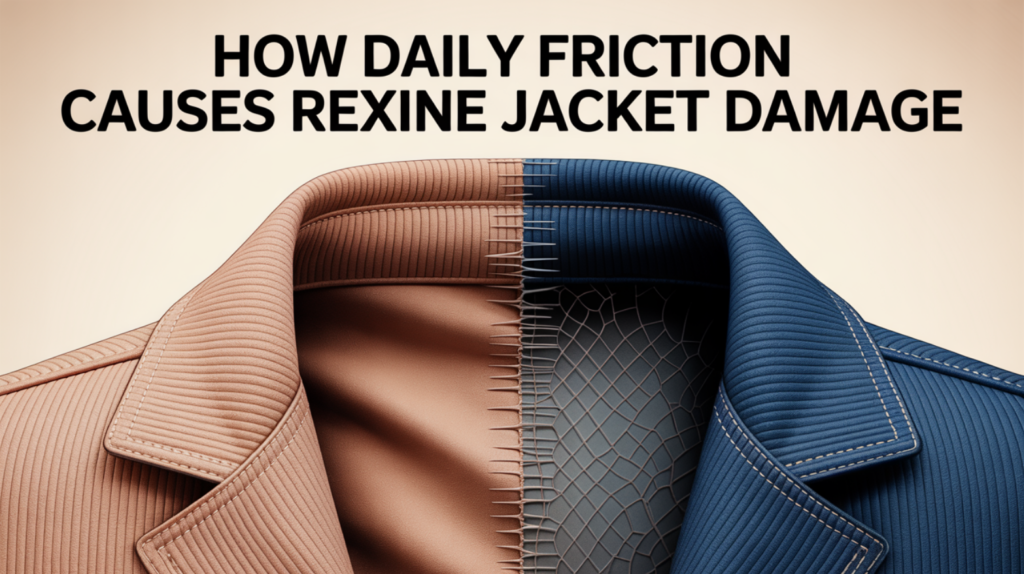
Each time the jacket rubs against objects, surfaces, or even the wearer’s own body, microscopic stress accumulates within the material.
This steady process forms a critical part of the deterioration patterns described in the environmental & usage damage on rexine jackets guide.
How Friction Gradually Breaks Down the Surface
Everyday movement creates countless points of contact between the jacket and the surrounding world.
Backpack straps, seat belts, chair backs, desk edges, and even arm motion produce friction against the rexine surface.
Each contact removes a tiny amount of the protective coating.
Over months of wear, these losses accumulate, thinning the surface until the backing fabric becomes vulnerable.
This is why friction-related damage often appears first at elbows, cuffs, shoulders, and collar edges.
Why Friction Works Together with Environmental Stress
Friction becomes even more damaging when combined with other environmental forces.
When the surface has already been weakened by moisture, as described in humidity and moisture damage on rexine jackets, abrasion removes material far more quickly.
If heat has also reduced flexibility, as explained in heat damage on synthetic leather jackets, the surface cracks instead of bending smoothly.
Together, these stresses accelerate the jacket’s structural decline.
The Slow Progression of Friction Damage
Friction damage does not appear overnight.
It develops through a clear sequence:
- loss of surface smoothness
- thinning of protective coating
- exposure of underlying fabric
- cracking at high-movement zones
- surface peeling and flaking
Because this damage progresses gradually, early recognition offers the best chance of prevention.
Conclusion
Daily friction damages rexine jackets by steadily wearing away the protective surface layer and exposing the weaker material beneath.
When combined with moisture, heat, and sunlight, this process accelerates dramatically.
Reducing direct abrasion, rotating usage, and being mindful of high-contact zones can significantly slow this deterioration and preserve the jacket’s appearance and structure over time.